AI & Models
Google launches Gemini 3.5 Flash for agentic AI tasks
Google launched Gemini 3.5 Flash, a new AI model designed for autonomous agentic tasks and faster performance, now available globally across its ecosystem.
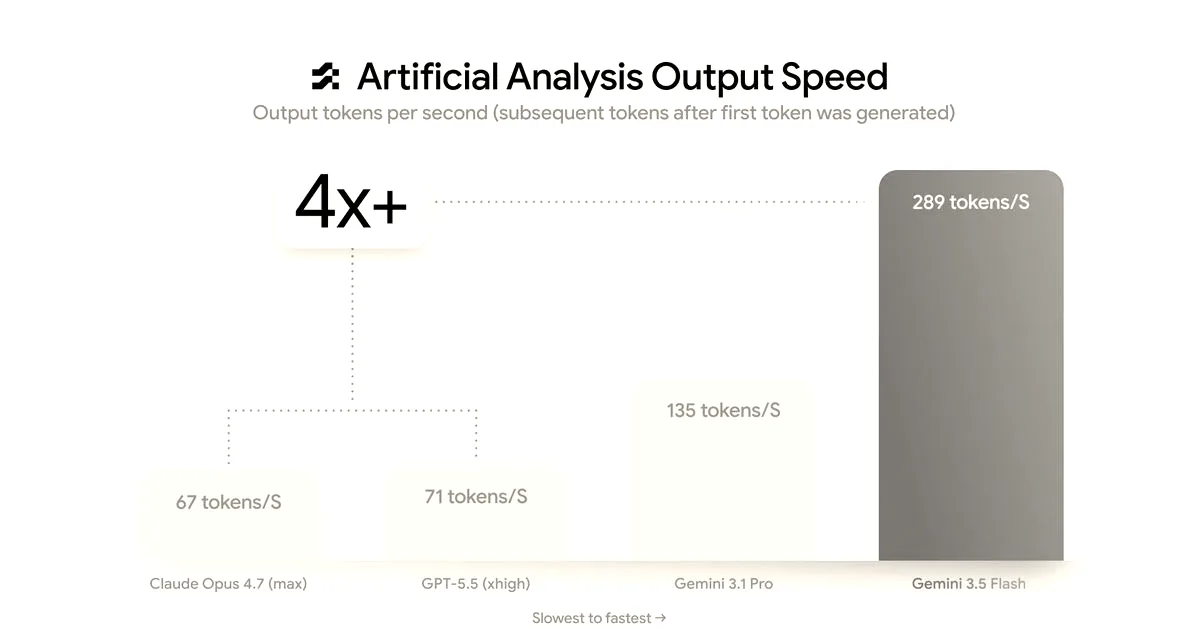
On Tuesday, Google launched Gemini 3.5 Flash, a new AI model that the company asserts is its strongest yet for coding and autonomous AI agents. Google defines an agentic tool as AI capable of planning and executing tasks with minimal human input. According to Google, the model can independently execute coding pipelines, manage research projects, and build an operating system from scratch. DeepMind’s chief technologist, Koray Kavukcuoglu, spoke to reporters on Monday, stating that 3.5 Flash offers a strong combination of quality and low latency. Kavukcuoglu attributed a 4x speed increase to the model compared to other frontier models, and noted that it outperforms the 3.1 Pro model on nearly all benchmarks. He also stated that an optimized version of Flash is 12x faster while maintaining the same quality.
The model is designed to work closely with Antigravity 2.0, Google’s agentic development platform and IDE (Integrated Development Environment). During a demonstration, Google engineer Varun Mohan showed agents working on separate components before coming together to build an operating system inside the platform. In this ecosystem, Google plans for Gemini 3.5 Pro, a forthcoming AI model, to work in tandem with Flash. Tulsee Doshi, Google’s senior director and head of product, explained: “3.5 Pro becomes your orchestrator, your planner, and then it actually can leverage Flash to be the various sub-agents.” Additionally, the model will power Gemini Spark, a new personal AI agent designed to run 24/7 to help consumers manage their digital lives. While the model can run autonomously for multiple hours, Doshi noted that it will at times pause and ask for user input when it hits a decision point or permission issue.
As Google deploys these autonomous capabilities globally, it has introduced strengthened cyber and CBRN (chemical, biological, radiological, and nuclear) safeguards. These safety measures arrive amid ongoing legal challenges for the company’s AI efforts. Google is currently facing a lawsuit after a man nearly committed a mass casualty event and died by suicide following weeks of chatting with Gemini last year.
Why it matters
The release signals Google’s shift from pitching AI as a conversational tool to AI as an agentic tool, focusing on planning, building, and iterating on real work with minimal human input.