Apps & Consumer
Runway launches a router to pick the best AI media model
Runway launched Media Router, a tool that automatically selects the best image, video, or audio generation model for a developer's request based on quality, speed, or cost.
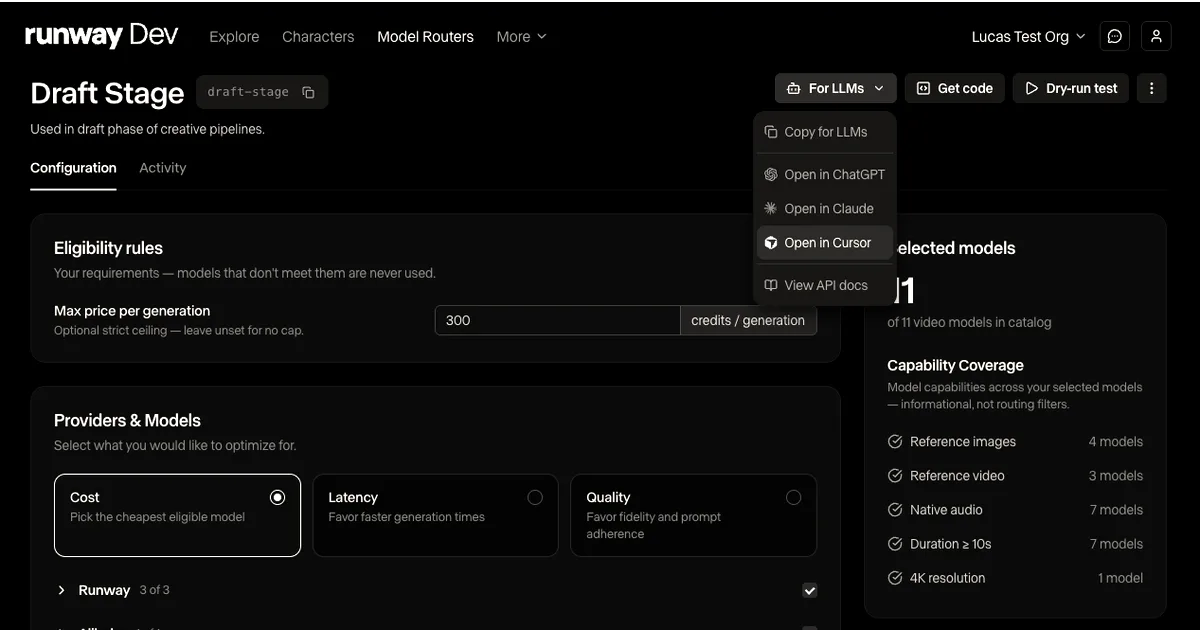
Runway launched Runway Media Router on Thursday through Runway Dev, the developer platform it introduced earlier this month that gives outside developers API access to a growing roster of third-party image, video, and audio models alongside Runway’s own. The tool automatically selects the best image, video, or audio generation model for a given request, based on whether a developer prioritizes quality, speed, or cost. Runway says it is the first router built specifically for generative media, even as model routers have become common in the large-language-model world.
“The routing really fits into that overall promise of being the easiest one-stop shop for developers to integrate with any type of generative media model,” Runway chief product officer Anthony Maggio told TechCrunch. Through Runway Dev, customers including Adobe, Cloudflare, ElevenLabs, Expedia, Shutterstock, and Quora can build media generation directly into their own products using Runway’s API instead of sending users to Runway’s own app or site.
The router arrives as the number of generative media models has exploded, making it harder for developers to evaluate each new release. Maggio said Chinese generative media models are becoming increasingly popular, but noted that some businesses uncomfortable working with Chinese-origin models could set a preference for American providers — a preference he said may grow as the Trump administration explores bans and sanctions against Chinese open AI models. Maggio said customers are mainly interested in routing for token pricing and quality; the launch comes weeks after Runway replaced its unlimited subscription plans with token-based pricing, a shift that drew criticism from some users. On quality, the router’s recommendations draw on Runway’s in-house creative team, which evaluates output across media types — how video models handle motion, how image models handle composition, how voice models handle lip-syncing.
Runway had already built a similar intelligence layer for its agent product, a conversational AI creative partner launched in May that turns text prompts into edited, multi-shot videos and campaigns; the Media Router packages that same routing technology for outside developers. The strategy reflects how competitive the generative media market has become. Runway’s last dedicated video model, Gen 4.5, topped leaderboards when it launched in December, and the company released its first world model that same month, but aside from a May upgrade to its video-editing model, Aleph 2.0, it hasn’t shipped a new frontier video model in months. Aleph 2.0 still ranks among the top video-editing models on Artificial Analysis, but Runway’s text-to-video and image-to-video models no longer lead the rankings, with the top 20 spots now dominated by Google, ByteDance, and Alibaba.
Why it matters
Runway is betting that developers won’t commit to any single model staying on top of a fast-moving field, positioning itself as the orchestration layer that survives regardless of which frontier model wins any given month. If the strategy works, Runway’s business shifts away from having to keep releasing the best model and toward keeping developers wired into its platform.