Markets & Business
IQM lists on Nasdaq as quantum sector faces commercial uncertainty
Finnish quantum computing firm IQM has gone public on the Nasdaq via a SPAC merger at a valuation of about $1.9 billion.
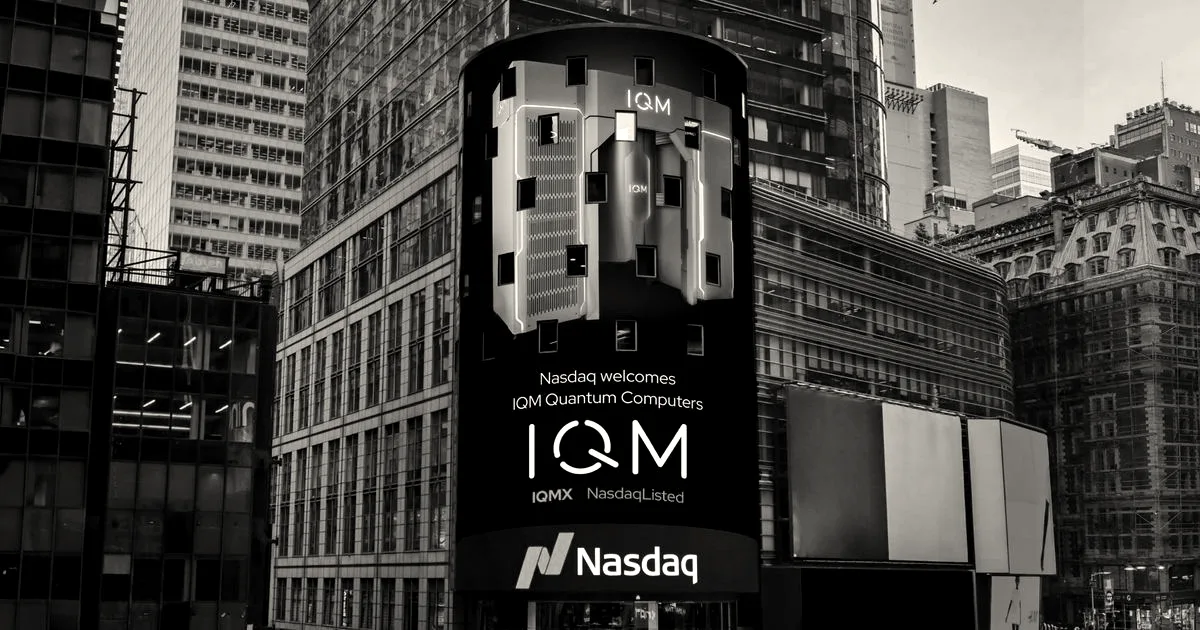
IQM, a quantum computing company based in Finland, has officially listed on the Nasdaq stock exchange following a merger with a Special Purpose Acquisition Company (SPAC)—a blank-check company used to take private firms public. The transaction valued the company at about $1.9 billion. However, the public market debut met with immediate headwinds, as IQM’s share prices spent most of the day below the initial public offering price on Thursday. The listing is expected to generate approximately €198 million ($226 million) in liquidity for the company after costs, adding to the $300 million the firm raised in a previous funding round.
The lukewarm market reception coincides with a stark warning in the company’s own prospectus. In the filing, IQM admitted that “large-scale commercial traction of quantum computing technology may never occur.” This disclosure highlights the deep technical and commercial hurdles facing the entire sector. While the industry is racing toward “quantum advantage”—the point where quantum chips outperform classical computers—no firm has yet proven when this threshold will be crossed.
Despite these long-term uncertainties, IQM has managed to expand its current commercial footprint. The company grew its customer base from eight customers in 2024 to 22 in 2025. The firm generates revenue by selling physical hardware to research centers and selling computing time through the cloud. Its current customer roster includes the VTT Technical Research Centre of Finland and the Leibniz Supercomputing Centre in Germany. “We sell computers into advanced supercomputing centers and data centers, and we sell computing time through the cloud,” said Jan Goetz, IQM’s CEO and co-founder.
IQM is attempting to balance its European roots with an expansion into the U.S. market. The company, which was founded in 2018 as a spinout from Aalto University, still keeps two-thirds of its 420-people team in Espoo, Finland, and another hundred employees in Munich, Germany. However, it has also established a presence in Maryland and deployed a computer at the Oak Ridge National Laboratory. This U.S. footprint positions the company to potentially benefit from American state initiatives, such as the U.S. Department of Energy’s commitment to deploying the world’s first fault-tolerant, scientifically relevant quantum computer by 2028. Meanwhile, IQM is also due to debut on Nasdaq Helsinki, maintaining its ties to European backers like Tesi, Finland’s sovereign wealth fund. The company’s blank-check partner, RAAQ, noted that European sovereign states and companies have supported IQM’s emergence through over €200 million in public support.
Why it matters
IQM’s public listing highlights the tension between the long-term promise of quantum computing and the immediate, uncertain commercial reality facing the sector. While government commitments and customer acquisition show active interest, the industry must still prove it can achieve quantum advantage to justify its multi-billion-dollar valuations.