Apps & Consumer
Freecash removed from app stores following deceptive marketing claims
Apple and Google removed the rewards app Freecash from their stores following allegations of deceptive marketing and potential data harvesting.
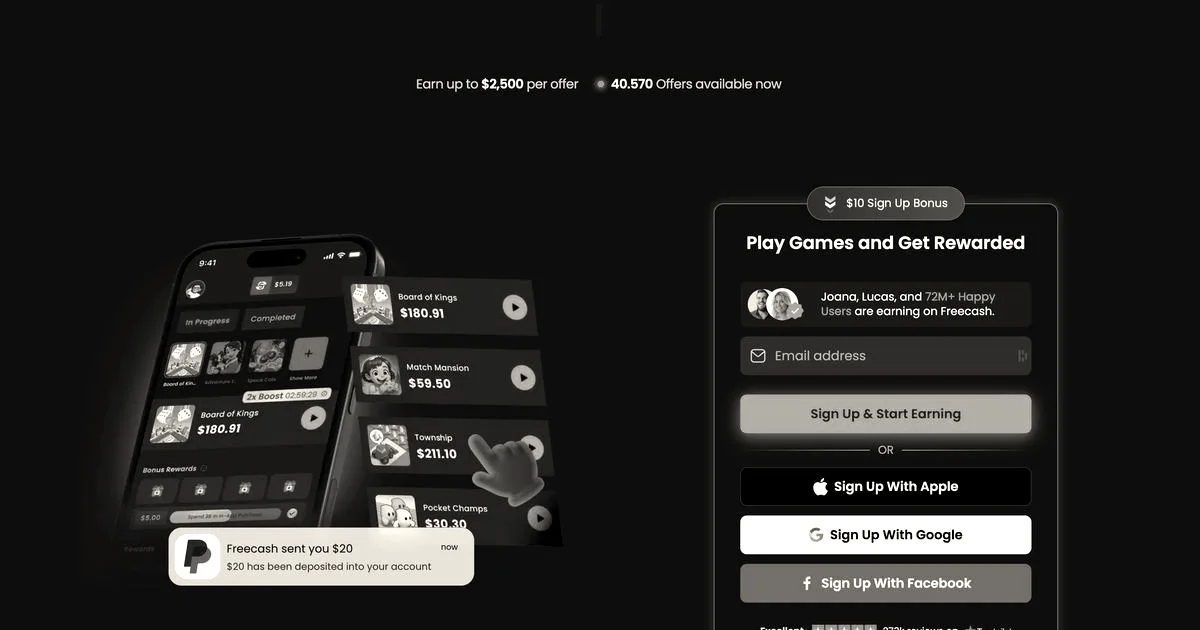
Apple and Google have removed the consumer rewards app Freecash from their respective app stores following reports of deceptive marketing and potential data harvesting. On Monday, Apple pulled Freecash from its App Store, citing violations of its rules regarding misleading marketing. Google confirmed the app was removed from the Play Store on April 15, 2026. The app had quickly risen to the top charts on the U.S. App Store and Google Play. According to market intelligence firm Appfigures, Freecash’s global downloads shot up to 5.5 million in January 2026, up from 876,000 in October 2025. Downloads peaked in February at nearly 6 million before declining to an estimated around 3 million installs for April. Despite the controversy, the app maintained a review score of 4.7 stars.
The app, owned by German company Almedia, scammed its way to the top of the app stores, according to TechCrunch. While marketed as a way to make money, cybersecurity company Malwarebytes reported that the app may collect sensitive information about users, including race, religion, sex life, sexual orientation, health, and biometrics. Furthermore, according to Wired, Freecash used deceptive marketing techniques and nudged users to spend money in games, leading to allegations of financial misrepresentation.
Investigations suggest Almedia may have circumvented previous platform bans by re-listing the app under different developer accounts. Almedia first submitted Freecash to the Apple App Store on March 24, 2024, but the app was removed on June 13, 2024, after an estimated 69.5K downloads. Months later, a Cyprus-based developer, 256 Rewards Ltd, rebranded its existing app as Freecash. This maneuver resembles a bait-and-switch—a deceptive marketing tactic where a product is advertised differently than it actually functions. Using another developer account to re-enter the app stores is a tactic associated with fraudulent apps. A similar pattern occurred on the Google Play Store, where the original app was removed in January 2024 before being re-listed under a different developer ID.
Almedia denied allegations of driving artificial traffic or using deceptive marketing. James Law, Almedia’s PR manager, stated: “Our apps are fully compliant with the Apple App Store and Google Play Store policies, as demonstrated by the fact that they are live and regularly pass platform reviews”. Law also noted that the company does not comment on internal product strategy regarding specific app listings.
Why it matters
The removal of Freecash highlights the ongoing challenge platforms face in policing deceptive marketing and bait-and-switch tactics used by apps to artificially inflate their rankings.